
Most SEO case studies show you a screenshot and ask you to trust the number. This one shows you the actual mechanics behind it — because a mobile pet grooming business considering SEO doesn’t just want proof it works. It wants to understand why it works, so it can judge whether the process behind it is legitimate.
Here’s what a mature, well-executed mobile pet grooming SEO campaign looks like after sustained work, using real dashboard data from a client we’ll call Doctor Groomer.
The Numbers
Google Search Console (trailing 6 months):
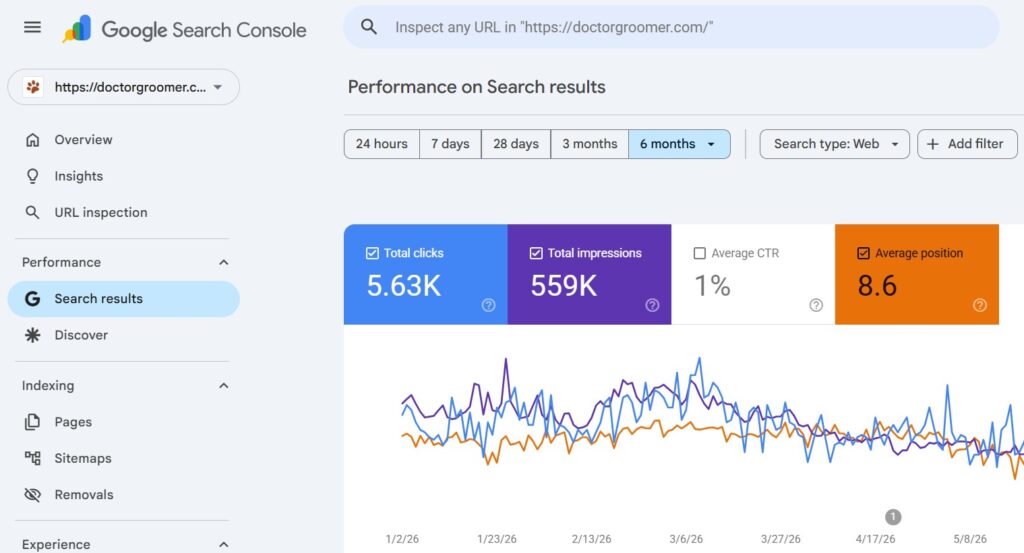
- 5.63K total clicks
- 559K total impressions
- 1% average CTR
- 8.6 average position — solidly on page one for a competitive local service category
Google Business Profile (Feb–May 2026, year-over-year):
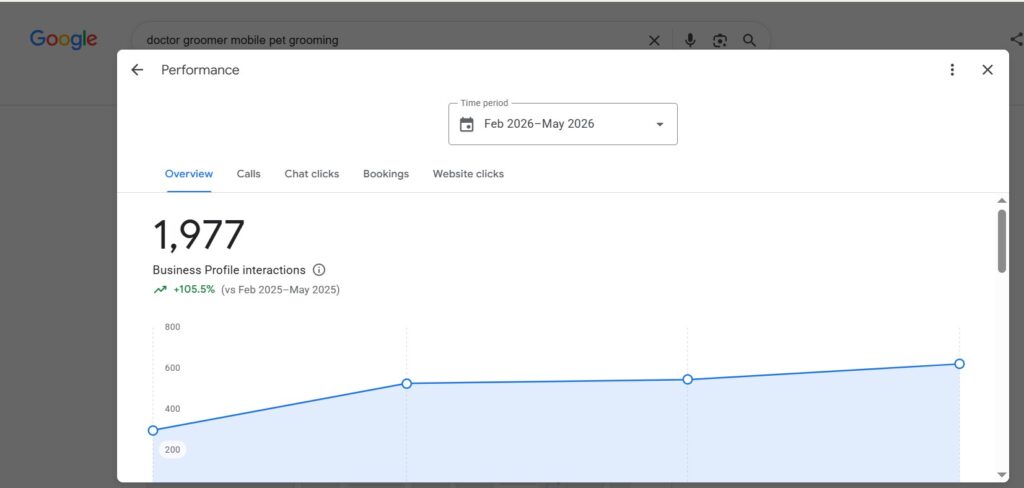
- 1,977 total Business Profile interactions, up 105.5% vs the same period last year
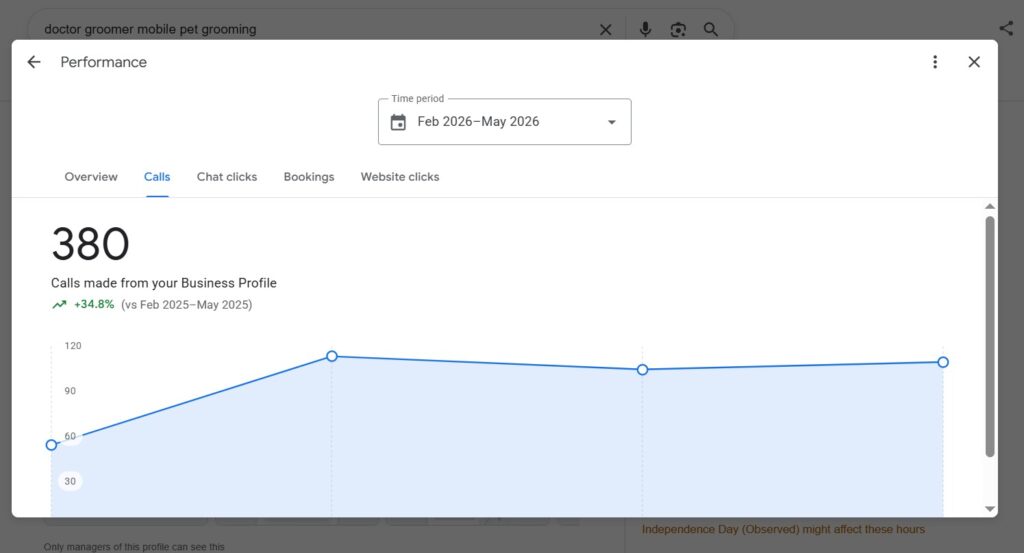
- 380 calls made directly from the Business Profile, up 34.8% year-over-year
What makes this data set meaningful isn’t just the totals — it’s the year-over-year comparison. This isn’t a temporary spike. It’s a business that was already ranking a year ago and has since roughly doubled its visibility. That’s what compounding SEO looks like once it moves past the initial 3-6 month ramp-up and into year two and beyond.
Why the Curve Looks Like This
Look closely at the shape of the Business Profile interactions graph: a sharp early climb, followed by a plateau at a much higher baseline. That plateau is the important part. It means the visibility isn’t a one-time peak — it’s a new, sustained floor. The business isn’t fighting to get back to where it was; it’s building forward from a permanently higher starting point.
That’s the real difference between short-term local SEO tactics and a long-term strategy. The goal was never to hit a peak once. It was to move the baseline and keep it there.
How to Get This Kind of Result
If you’re a mobile pet grooming business wondering what actually produces numbers like these, here’s the real framework — no shortcuts, no hacks:
1. Fully optimize your Google Business Profile, and keep optimizing it.
Categories, service areas, services list, photos updated regularly, and posts on a consistent cadence. Most groomers set this up once and forget it. The businesses that win keep touching it monthly.
2. Build dedicated pages for every city and service area you cover.
Google needs a reason to show you for “mobile dog groomer [city].” A single generic homepage rarely ranks for more than one location.
3. Generate reviews consistently, not in bursts.
A steady drip of new reviews signals an active, trustworthy business. A pile of 20 reviews from three years ago signals the opposite.
4. Get listed and cited consistently across local directories.
NAP (name, address, phone) consistency across citations is a foundational trust signal that’s easy to overlook and expensive to ignore.
5. Publish content that answers real pet owner questions.
Search intent around pet grooming is highly local and highly practical — think seasonal grooming needs, pricing transparency, and mobile-specific FAQs, not generic blog filler.
6. Track the metrics that matter, not the ones that look good.
Impressions are nice. Calls and bookings pay your bills. If your reporting doesn’t tie back to those, you don’t actually know if it’s working.
7. Give it time, and don’t stop the moment you see progress.
The businesses that produce graphs like Doctor Groomer’s are the ones that treated month six as the starting line, not the finish line.
The Honest Part
Here’s what most owners find out the hard way: every step above is simple to understand and genuinely difficult to execute consistently, especially while you’re also running a business, driving to appointments, and managing clients. The businesses that hit numbers like this almost never did it in spare evenings between jobs. They had a system running in the background, month after month, whether they had time to think about SEO that week or not.
That’s usually the actual gap between businesses that see this kind of growth and businesses that stay flat for years. Not the strategy itself, but whether someone was consistently executing it.
If you’re looking at a framework like this and thinking about how much of it you can realistically stay on top of yourself versus where you’d want an extra set of hands, that’s a conversation worth having before you decide either way.